 Ultra Garage Door Services Services
6 hours ago in Home Services
High Authority Social Bookmarking Site for US SEO in 2026 - A2Bookmarks USA
Welcome to A2Bookmarks USA, your leading social bookmarking site designed for immediate digital impact across the United States. Our platform provides a powerful, specialized network that enables users to instantly share, organize, and elevate their most valuable web resources. As a premier choice among US social bookmarking sites in 2026, A2Bookmarks USA is engineered to maximize your content's shelf life, search engine indexing, and organic discoverability. Entrepreneurs, marketers, and creators rely on our platform to secure authoritative, geo-targeted backlinks that build lasting domain strength. Streamline your content strategy, connect with an engaged American audience, and leverage data-driven bookmarking features tailored for competitive U.S. markets. Gain the visibility advantage and accelerate your SEO results with a platform built specifically for the American digital landscape. Join A2Bookmarks USA and start building your authoritative link profile today.
What Houston Homeowners Should Know Before Installing a New Garage Door
Ultra Garage Door Services Services
6 hours ago in Home Services
Replacing a garage door is one of the most visible upgrades you can make to a home’s exterior—and one of the most important for daily convenience, energy efficiency, and storm protection. Because a two-car garage door often accounts for up to a third of a house’s front facade, choosing the right style, material, and structural rating immediately shapes both curb appeal and long-term performance.
For homeowners across Greater Houston, however, shopping for a replacement door involves far more than picking a color and window pattern out of a catalog. Between triple-digit summer heat, year-round Gulf Coast humidity, strict local wind-load building codes, and HOA architectural guidelines, planning ahead prevents costly surprises on installation day. Reviewing the key technical and practical factors before ordering ensures your new door fits smoothly, operates quietly, and stands up to Southeast Texas weather for decades.
Navigating Houston Wind-Load Requirements and Building Codes
Because Greater Houston sits along the upper Texas Gulf Coast, tropical storms and hurricane-force gusts are an unavoidable reality. Even inland neighborhoods across Harris, Fort Bend, and Montgomery counties fall under specific municipal wind-speed design zones—while homes closer to Galveston Bay and Clear Lake face even stricter coastal windstorm rules under the Texas Department of Insurance (TDI).
A garage door is the largest unbraced opening on most residential structures. During severe windstorms, a non-reinforced door can buckle inward or blow off its tracks, allowing rapid internal air pressure buildup that puts the entire roof structure at risk.
Modern wind-rated doors incorporate specialized structural reinforcements:
- Heavy-Gauge Vertical Tracks: Thicker 14-gauge steel tracks engineered to resist bending under positive and negative wind pressure.
- Horizontal Steel Reinforcement Struts: Galvanized U-shaped steel braces bolted across the back of individual door sections.
- Heavy-Duty Hinges and Long-Stem Rollers: Reinforced hardware that keeps rollers seated inside the track channel during strong gusts.
Working with experienced local specialists for New Garage Door Installation Houston ensures your new door carries the proper wind-load engineering label for your exact zip code and meets local permitting standards.
Comparing Garage Door Materials for Gulf Coast Heat and Humidity
Houston’s climate combines intense UV exposure, 100°F+ summer afternoons, and high relative humidity—conditions that can warp untreated wood or rust poorly coated hardware. Comparing the four most popular residential door materials helps match durability and maintenance expectations to your budget.
| Door Material | Durability in Houston Climate | Maintenance Requirements | Insulation Potential | Ideal Home Style |
| Insulated Galvanized Steel | High; resists warping, cracking, and insects when properly coated | Low; occasional washing and twice-yearly hardware lubrication | High (up to R-18+ with polyurethane core) | Traditional, transitional, and modern suburban homes |
| Faux-Wood Composite Overlay | Very high; molded composite resists moisture, rot, and termites | Low; never needs restaining like natural cedar | High (built over insulated steel base) | Craftsman, Hill Country, and luxury carriage-house homes |
| Aluminum & Tempered Glass | High; naturally rust-proof frame suited for humid air | Low to moderate; glass panels require regular cleaning | Moderate (depends on insulated/tinted glazing) | Contemporary and mid-century modern architecture |
| Natural Solid Wood (Cedar/Redwood) | Moderate; susceptible to moisture swelling and UV fading without care | High; requires periodic sealing, staining, or painting | Moderate (natural wood insulates moderately) | Custom estates and historic residences |
Why Multi-Layer Steel Construction Is So Popular
For most Houston homeowners, three-layer (“sandwich”) steel construction offers the strongest balance of value, quiet travel, and durability. These doors bond a dense insulation core between two sheets of hot-dipped galvanized, baked-enamel steel—preventing the hollow, tinny rattling common with single-layer “pan” doors while resisting dents from stray basketballs or hail.
Understanding Insulation and R-Value in an Unconditioned Garage
Many homeowners assume garage door insulation only matters in northern states with freezing winters. In Greater Houston, insulation works just as hard keeping extreme summer heat out—especially if your garage sits beneath an upstairs bedroom, shares a wall with your kitchen or living room, or houses a home gym, workshop, or extra refrigerator.
Insulation performance is measured by R-value (the higher the number, the greater the thermal resistance):
- Non-Insulated Doors (R-0): A single layer of stamped steel. Affordable upfront, yet transfers outdoor heat directly into the garage and transmits more operating noise.
- Polystyrene-Insulated Doors (R-6 to R-9): Rigid foam boards fitted inside the steel panels. Noticeably quieter and stronger than non-insulated doors, offering solid value for detached garages.
- Polyurethane-Insulated Doors (R-12 to R-18+): Liquid foam injected under pressure that expands to fill every cavity and bonds directly to the steel skins. Polyurethane delivers the highest thermal barrier, dramatically stiffens each panel against wind pressure, and creates whisper-quiet operation.
Pairing an R-12+ polyurethane door with fresh perimeter vinyl weatherstripping and a thick rubber bottom astragal seal can reduce peak afternoon garage temperatures noticeably while easing the workload on adjacent living-space air conditioners.
Checking Opener Compatibility, Springs, and Framing Before Installation
Installing a new door is the ideal time to verify that your supporting hardware and opener are ready for the new door’s exact weight and dimensions.
1. New Torsion Springs Matched to Exact Door Weight
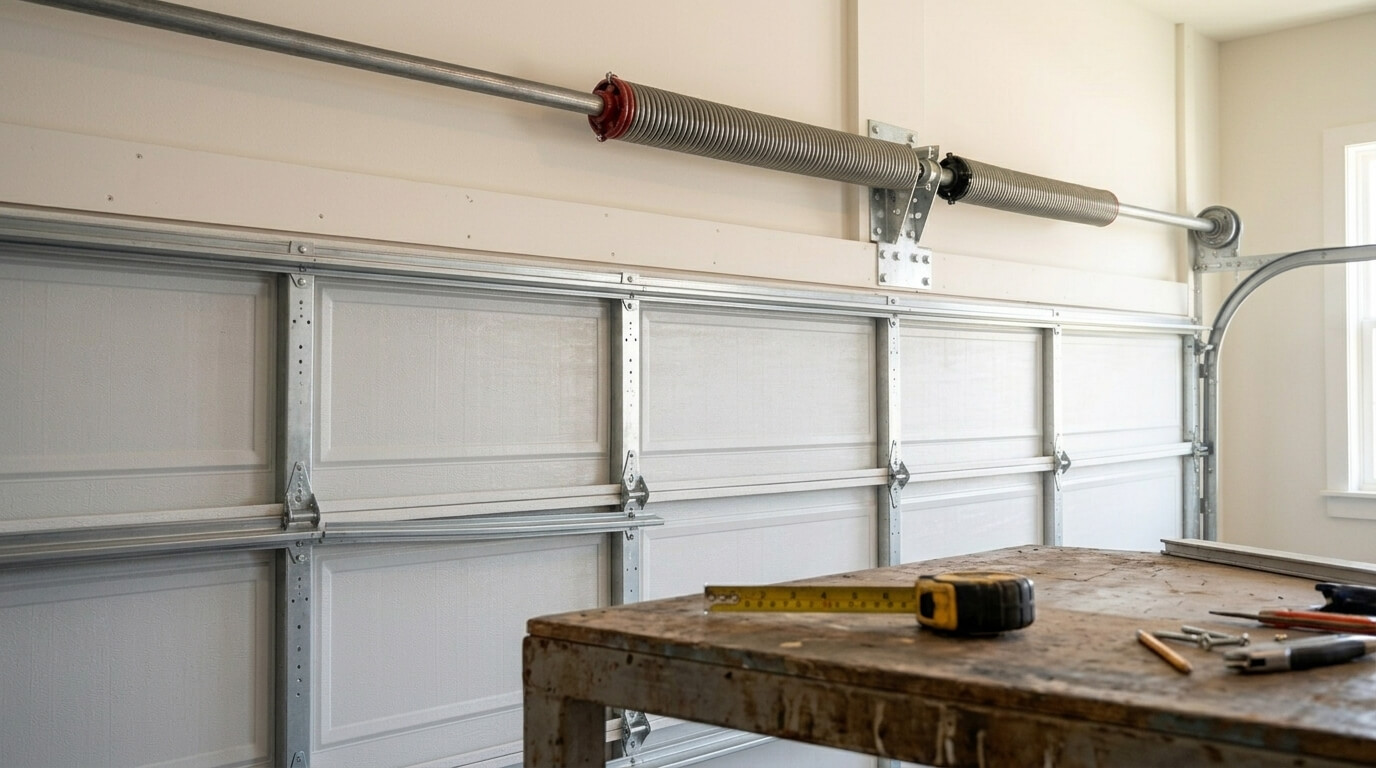
Adding insulation, decorative windows, and horizontal wind struts makes a modern door significantly heavier than an older non-insulated panel door. Reusing old torsion springs on a heavier replacement door will throw off mechanical balance immediately. Every new door installation should include fresh torsion springs engineered specifically for the new door’s dead weight and height, paired with new lift cables and sealed ball-bearing nylon rollers.
2. Electric Opener Condition and Headroom Clearance
If your existing belt-drive or chain-drive opener is under 8 to 10 years old, operates smoothly, and meets UL 325 safety sensor standards, it can usually be reconnected to your new door. However, if your current opener is noisy, lacks modern rolling-code encryption or battery backup, or needs frequent Garage Door Repair, upgrading the motor unit at the same time often saves on combined labor costs.
3. Wood Framing, Jambs, and Overhead Clearance
Before ordering a door, a technician should verify four critical garage measurements:
- Rough Opening Width and Height: Standard sizes are typically 16′ x 7′ or 16′ x 8′ for two-car bays, and 8′ x 7′ or 9′ x 7′ for single-car bays.
- Side Room: At least 3.75 to 4.5 inches of solid wood framing on each side of the opening to anchor vertical tracks.
- Headroom: Typically 12 to 15 inches of unobstructed space above the header for torsion springs, drums, and horizontal track curves (low-headroom track kits are available for tighter garages).
- Backroom Depth: Unobstructed ceiling depth equal to the door height plus at least 18 to 24 inches for horizontal tracks and the opener rail.
(Tip: Inspect the bottom of your wooden side jambs near the concrete floor for termite damage or moisture rot—replacing damaged wood trim before the new tracks go up guarantees rock-solid anchoring.)
HOA Guidelines and Design Choices That Boost Curb Appeal
Across master-planned communities in Katy, Sugar Land, Cypress, Kingwood, and Clear Lake, Homeowners Associations frequently maintain specific rules governing garage door colors, raised-panel vs. carriage-house profiles, and window placements. Securing written architectural review approval before placing a custom door order avoids costly restocking fees.
When selecting finishes and windows:
- Top-Row Windows: Placing tempered frosted, obscure, or seeded glass along the top section brings natural daylight into the garage while preserving privacy from the street.
- Color Fastness: Dark charcoal, espresso, and black doors look striking on modern brick and stone homes, though choosing factory-baked UV-resistant finishes (and insulated construction) helps prevent heat-related fading or thermal bowing on west-facing driveways.
Frequently Asked Questions
How long does a new residential garage door installation take?
Once your selected door arrives from the manufacturer or local warehouse, removing the old door, installing new tracks, torsion springs, panels, and perimeter seals, and reconnecting the opener typically takes three to five hours for a standard residential bay.
Should I replace my garage door opener at the same time as my door?
Not necessarily. If your existing opener is in good mechanical condition, has intact photoelectric safety sensors, and is rated for your new door’s weight, it can be reconnected cleanly. However, if your opener is over 12 years old or lacks battery backup for storm outages, bundling a new DC belt-drive opener during door installation is convenient and cost-effective.
Do I need a windstorm-rated garage door in Houston?
Yes. Greater Houston municipalities enforce wind-load building codes based on proximity to the Gulf Coast. Installing a door engineered and labeled for your local wind-speed zone protects your home during tropical storms, satisfies city inspection rules, and helps maintain homeowners insurance compliance.
How much maintenance will a new insulated steel garage door need?
Very little. Hose off dust and pollen a couple of times a year, inspect the bottom rubber seal annually, and apply a silicone- or lithium-based garage door lubricant to the torsion springs, hinges, and roller bearings every six months to keep movement quiet and smooth.
Conclusion
Investing in a new garage door upgrades your home’s curb appeal, strengthens storm protection, and improves everyday comfort inside your garage. By verifying your local Houston wind-load rating, choosing durable multi-layer insulated construction suited for Gulf Coast heat and humidity, confirming HOA guidelines, and ensuring fresh springs and sound framing are part of the job, homeowners can enjoy smooth, quiet, and dependable operation for many years to come.
Report Story
Related Stories










Recent Stories